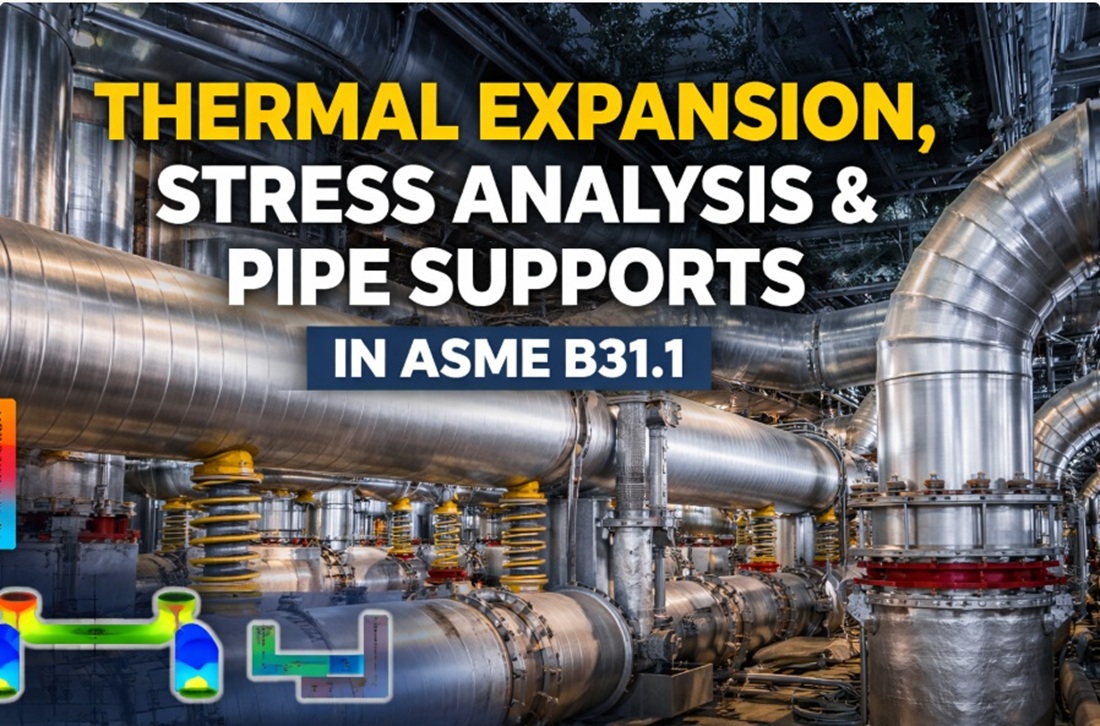
Learn how thermal expansion, stress analysis, and pipe supports are handled in ASME B31.1 power piping. Practical examples, plant failures, and beginner-friendly explanations by an experienced piping engineer.
Table of Contents
Introduction
Why Thermal Expansion Matters in Power Piping
In power plant piping systems, temperature is the real enemy—not pressure.
Many junior engineers focus heavily on design pressure, wall thickness, and piping class selection. These are important, but in ASME B31.1 Power Piping, the dominant design driver is thermal expansion.
A steam line that is perfectly safe for pressure can still:
- Crack at welds
- Pull equipment nozzles out of alignment
- Break pipe supports
- Cause turbine or boiler nozzle failures
This is why ASME B31.1 focuses on:
- Thermal expansion
- Stress analysis
- Flexibility
- Pipe supports
In real operating plants, most piping failures I have investigated were not pressure failures. They were thermal stress and poor support design failures.
This article using real plant examples, while keeping correct piping engineering terminology intact.
Why Thermal Expansion Dominates Power Piping Design
What Makes Power Piping Different?
Power piping systems (covered by ASME B31.1) typically operate at:
- High temperature (300°C to 600°C)
- Moderate to high pressure
- Long straight runs (main steam, hot reheat, cold reheat)
In comparison:
- Oil and gas piping (ASME B31.3) is often pressure-controlled
- Power piping is temperature-controlled
Thermal Expansion Basics
When metal is heated, it expands.
When restrained, it generates thermal stress.
In piping systems:
- The pipe wants to expand
- Structures, equipment, and anchors restrain it
- Stress develops at elbows, nozzles, welds, and supports
ASME B31.1 assumes thermal expansion stress is the governing stress for most power piping systems.
How Much Do Pipes Expand at High Temperature? (Practical Examples)
Thermal expansion is not theoretical—it is measurable and significant.
Basic Formula for Thermal Expansion
ΔL=L×α×ΔT
Where:
- ΔL = change in length
- L = original pipe length
- α = coefficient of thermal expansion
- ΔT = temperature change
Example 1 – Carbon Steel Steam Line
- Pipe length: 30 meters
- Material: Carbon steel (ASTM A106 Gr.B)
- Design temperature: 500°C
- Ambient temperature: 25°C
Thermal expansion ≈ 90 mm
👉 That is almost 4 inches of movement.
If this movement is restrained:
- Elbow overstress
- Weld fatigue
- Support damage
Example 2 – Stainless Steel Line
Stainless steel expands 30–40% more than carbon steel.
A 30-meter stainless steel line at 500°C can expand 120 mm or more.
This is why material specification selection directly impacts stress analysis.
Sustained Stress vs Expansion Stress in ASME B31.1
ASME B31.1 separates stresses into categories.
Sustained Stress
Includes:
- Internal pressure
- Weight of pipe
- Weight of fluid
- Weight of insulation
- Weight of valves and fittings
Sustained stress is checked against allowable stress at design temperature.
This stress is mostly static.
Expansion Stress
Includes:
- Thermal expansion and contraction
- Cyclic movement during startup and shutdown
Expansion stress is:
- Self-limiting
- Cyclic
- Responsible for fatigue failures
ASME B31.1 allows higher expansion stress limits because:
- Yielding redistributes stress
- System stabilizes after initial cycles
But excessive expansion stress leads to:
- Low-cycle fatigue
- Cracking at weld toes
- Elbow ovalization
Expansion Control Methods in Power Piping
Thermal expansion cannot be eliminated—but it can be controlled.
1 Expansion Loops
Expansion loops add flexibility by increasing pipe length.
Advantages:
- Simple
- No special components
- Low maintenance
Disadvantages:
- Requires space
- Increases material quantity
Loops are common in:
- Pipe racks
- Long straight runs
2 Offsets
Offsets use directional changes to absorb movement.
Typical examples:
- Z-shaped routing
- L-shaped routing
Offsets are often used where:
- Space is limited
- Equipment locations already force changes in direction
3 Flexibility Through Routing
Good piping engineers use routing as a stress control tool.
Examples:
- Avoiding straight rigid runs
- Introducing elevation changes
- Using elbows instead of straight connections
This is why piping layout experience is as important as software stress analysis.
Pipe Supports in ASME B31.1 Power Piping
Pipe supports are not just structural items—they are stress control devices.
1 Anchors
Anchors:
- Prevent all movement
- Transfer loads to civil structure
Incorrect anchor placement is a common cause of high stress.
Anchors should be:
- Strategically located
- Coordinated with stress analysis
2 Guides
Guides:
- Allow axial movement
- Restrict lateral movement
Used to:
- Direct thermal expansion
- Protect equipment nozzles
A guided system without a proper anchor is poor engineering practice.
3 Variable Spring Hangers
Used where:
- Vertical movement is moderate
- Load variation is acceptable
Common for:
- Medium temperature lines
- Short vertical movement
4 Constant Spring Hangers
Used where:
- Vertical movement is large
- Load must remain constant
Essential for:
- Boiler connections
- Turbine inlet piping
Incorrect spring selection leads to:
- Nozzle overload
- Pipe sagging
- Misalignment
Real Plant Failures Due to Poor Flexibility
Case 1 – Cracked Steam Line Weld
Cause:
- Straight run between two rigid anchors
- No expansion loop
- No flexibility analysis
Result:
- Weld crack after 18 months
- Forced shutdown
Case 2 – Turbine Nozzle Damage
Cause:
- Improper guide spacing
- Spring hanger locked during operation
Result:
- Excessive nozzle loads
- Turbine alignment issues
Case 3 – Support Steel Failure
Cause:
- Underestimated thermal movement
- Support designed as rigid instead of guided
Result:
- Structural steel deformation
- Safety incident
Frequently Asked Questions (FAQs)
Q1: Is stress analysis mandatory for all ASME B31.1 lines?
No. But it is mandatory for high-temperature, large-diameter, and equipment-connected lines.
Q2: Why is thermal expansion more critical than pressure in power piping?
Because temperature change causes large movements that generate cyclic stresses.
Q3: Can I rely only on software for stress analysis?
No. Software calculates stress, but engineering judgment defines routing and support philosophy.
Q4: What documents feed into stress analysis?
P&ID, line list, piping class, material specification, insulation data, and support drawings.
Conclusion – Engineer the Movement, Not Just the Pipe
In ASME B31.1 power piping:
- Pressure keeps the pipe round
- Temperature tries to tear it apart
Good piping engineering means:
- Understanding thermal expansion
- Designing flexibility into routing
- Selecting correct pipe supports
- Performing stress analysis when required
If you control movement, the pipe will last decades.
Ignore it—and the plant will teach you the lesson the hard way.