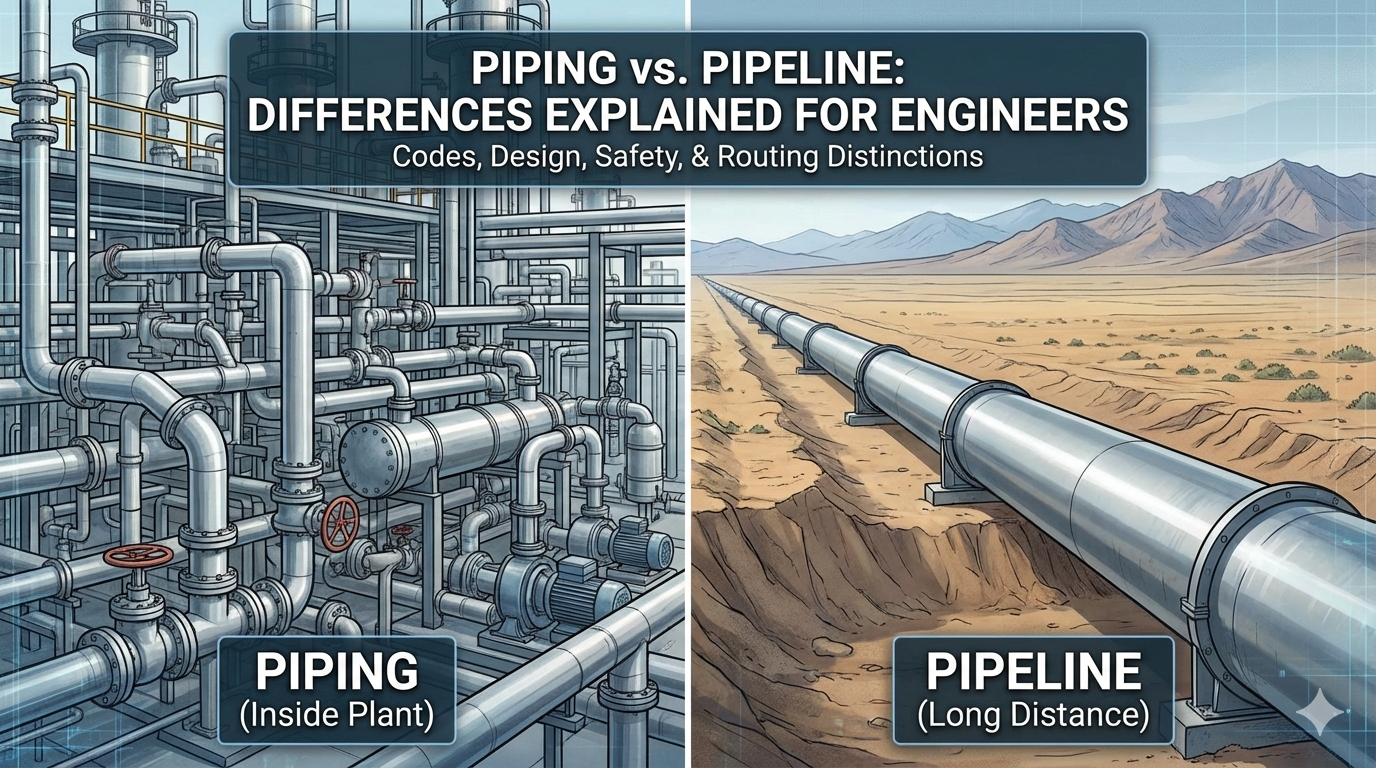
Piping vs Pipeline is one of the most important topics in mechanical and piping engineering. Although both systems are designed to transport fluids, piping vs pipeline comparisons are essential because they differ significantly in design philosophy, operating conditions, applicable ASME codes, construction methods, and maintenance requirements.
Choosing between a piping system and a pipeline affects every stage of an engineering project, from material selection and pressure design to stress analysis, fabrication, inspection, testing, and long-term operation. Applying the wrong design code or engineering approach can result in safety risks, increased costs, and code compliance issues.
In this comprehensive guide, you’ll learn the key differences between piping and pipeline, compare their applications, design principles, components, stress analysis methods, and applicable ASME B31 codes. Whether you’re preparing for an engineering interview, studying piping design, or working on industrial projects, this article will help you understand when each system should be used.
If you’re new to industrial piping, start with our guide on What is Piping? before exploring the differences between piping and pipelines.
Table of Contents
What Is Piping?
Piping is an engineered system used to transport fluids inside a plant or facility. It connects equipment such as pumps, pressure vessels, heat exchangers, compressors, and storage tanks to ensure the safe and efficient flow of process and utility fluids.
A typical piping system consists of pipes, fittings, flanges, valves, gaskets, bolts, and supports, all designed to work together under specified pressure, temperature, and operating conditions. To better understand these elements, read our detailed guide on Piping Components.
What Is a Pipeline?
A pipeline is used to transport fluids over long distances, usually outside plant boundaries. Pipelines are generally straight, have very few fittings, and are often buried underground or laid above ground across long routes.
Why this distinction matters: Codes, design philosophy, inspection, and maintenance differ for each system. Misidentifying a system can lead to using the wrong code or the wrong mechanical design assumptions.
Piping vs Pipeline: Key Differences
The following piping vs pipeline comparison highlights the major differences in design, construction, operation, applicable codes, maintenance, and engineering practices.
Piping is installed inside plants, has complex routing, and uses many components. Pipelines are installed over long distances with simple routing and minimal components.
Applicable Codes and Standards
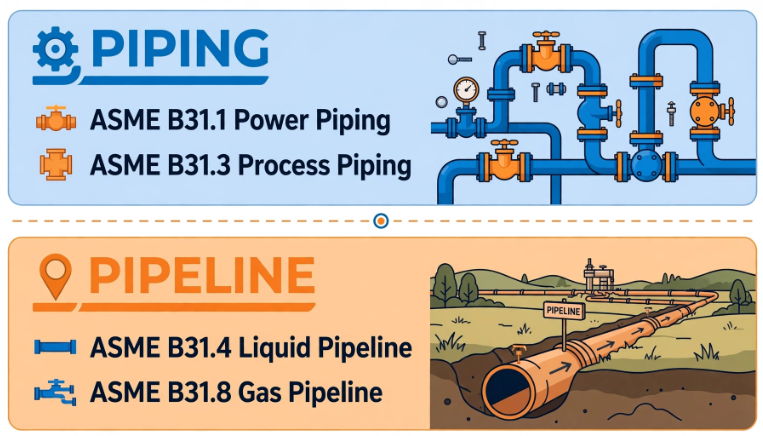
One of the biggest differences in piping vs pipeline design is the applicable ASME code used for each system. Piping and pipeline design follow different ASME standards:
- Piping systems inside industrial plants are commonly designed according to ASME B31.3 (Process Piping), while ASME B31.1 (Power Piping) is primarily used for power generation facilities. If you’d like to understand its scope and design requirements, read our complete ASME B31.1 Power Piping Guide.
- Pipeline systems are governed by ASME B31.4 (Pipeline Transportation Systems for Liquids and Slurries) and ASME B31.8 (Gas Transmission and Distribution Piping Systems) for gas pipelines.
Practical Tip: Before starting any piping or pipeline project, always identify the applicable ASME code. The selected code governs allowable stresses, design pressure, temperature limits, flexibility requirements, inspection methods, and testing procedures. Choosing the correct code at the beginning of a project helps ensure safe, reliable, and code-compliant system design. To understand how engineers determine allowable stress values, read our guide on ASME B31.1 Materials & Allowable Stress.
Design Philosophy: Layout, Flexibility, and Stress
When comparing piping vs pipeline, thermal expansion and flexibility play a much larger role in plant piping than in long-distance pipelines.
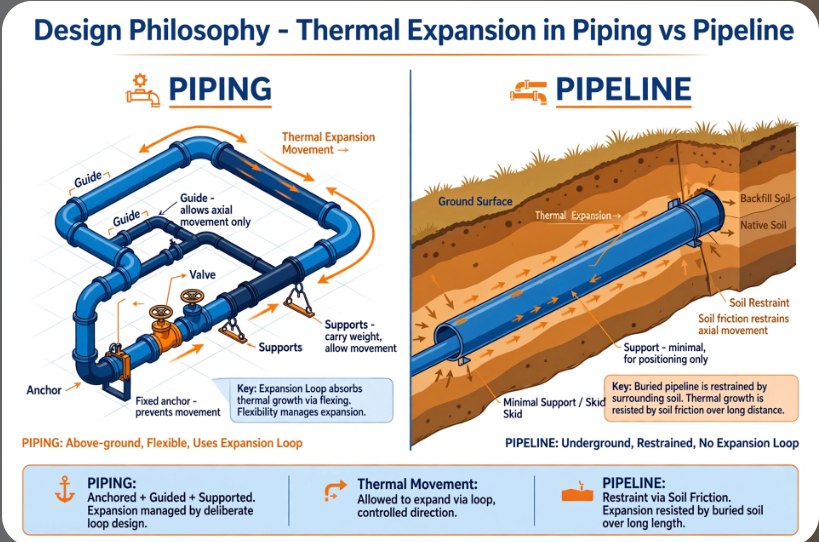
Thermal expansion is one of the most important considerations in piping design because excessive thermal movement can overload equipment nozzles and supports. Our article on ASME B31.1 Thermal Expansion Stress Analysis explains this topic in detail.
- Piping: Plant piping often has complex routing with many components and restraints. Thermal expansion and multiple anchor/guide points create significant stress analysis work. Pipe stress engineers must model thermal growth, include expansion loops or anchors, and ensure support spacing and flexibility comply with ASME B31.3 or B31.1 criteria.
- Pipeline: Pipeline behavior is influenced by soil interaction and route continuity. Pipelines are long and straight; thermal expansion is accommodated over long runs and by trenching or bends. Stress analysis for pipelines focuses more on longitudinal forces, buckling (for elevated temperature or subsea), and soil-pipeline interaction rather than the localized flexibility solutions common in plant piping.
Design note: Treat piping as a highly restrained system with multiple boundary conditions. Treat pipeline as a continuous structure interacting with its environment.
Components and Complexity
Pipeline: Few fittings are used (mostly bends, tees at limited locations). Pigging stations, block valves, and metering stations are spaced along the route. Corrosion protection (coatings, cathodic protection) and right-of-way management are major concerns.
Piping: Many fittings, valves, and supports are common. Specialty items (e.g., orifice runs, control valves) require careful local design. The presence of equipment imposes tie-in constraints and often forces complex three-dimensional routing.
Materials and Corrosion Management
Material selection is another important aspect of piping vs pipeline engineering because operating conditions and corrosion mechanisms vary significantly. Material selection follows the fluid, temperature, pressure, and expected corrosion. Choosing suitable Piping Materials depends on pressure, temperature, corrosion resistance, fabrication requirements, and the process fluid. For both piping and pipelines:
- Piping inside plants may require localized corrosion protection (liners, jackets) or corrosion-resistant alloys for severe service.
- Choose materials per corrosion allowance, H2S/CO2 content, and temperature limits. Learn how engineers determine the required Corrosion Allowance for carbon steel and alloy piping systems.
- Apply protective measures: coatings, linings, corrosion inhibitors, or cathodic protection for buried pipelines.
Supports, Anchors, and Expansion
Proper support design is one of the key differences in piping vs pipeline systems.
- Piping: Support design is critical. Supports must control vertical loads, limit vibration, and allow thermal movement. Proper support spacing also depends on pipe size, wall thickness, operating temperature, and material properties. Anchors and guides create reaction forces that drive stress analysis. Use spring supports and expansion loops where needed.
- Pipeline: Supports are fewer; soil provides lateral restraint. Above-ground pipelines require structural supports and attention to differential movement between supports. Buried pipelines rely on trench backfill and bedding for load distribution.
Inspection, Testing, and Maintenance
Inspection requirements also vary between piping vs pipeline applications because plant piping is generally more accessible than buried pipelines.
- Piping: Frequent inspections, hydrostatic testing, and access for maintenance are standard. Plant piping is accessible and often requires periodic NDT, visual checks, and inline inspections for special services.
- Pipeline: Pipelines are tested in large sections and use pigging (intelligent pigs) for internal inspection. Right-of-way inspection, leak detection systems, and cathodic protection monitoring are routine.
Safety and Risk Considerations
Safety considerations are another major difference in piping vs pipeline engineering projects.
- Piping: Higher component density and proximity to personnel require careful hazard analysis (HAZOP) and emergency relief systems sized per code. The design must consider potential jetting, BLEVE (for vessels), and flammable cloud dispersion.
- Pipeline: Long distance increases exposure to third-party damage (excavation), environmental sensitivity, and remote leaks. Emergency response planning and pipeline integrity management become critical.
Stress Analysis Methods and Best Practices
- Use finite element or dedicated pipe stress software to model piping systems with accurate boundary conditions and realistic thermal loads.
- Include weight, fluid mass, wind, seismic, and thermal effects per relevant codes.
- For pipelines, model longitudinal forces, lateral buckling, and soil interactions. Consider finite element continuum models for detailed subsea or high-temperature pipeline segments.
Common Mistakes and How to Avoid Them
- Applying the wrong code: Determine whether the system is piping or pipeline early in the project to select the correct standard.
- Underestimating thermal movement: Always model thermal growth and check support reactions.
- Ignoring corrosion protection: Both piping and pipelines need coherent corrosion management plans.
- Poor access planning: In-plant piping must allow maintenance access; pipelines must allow pigging and monitoring.
Piping vs Pipeline Example
- Piping tie-in to a heat exchanger: Proper pipe sizing, support selection, and flange connections are essential to ensure safe operation and minimize equipment nozzle loads. Requires 3D routing in limited space, multiple supports, spring hangers for thermal movement, and local flexibility for nozzle loads.
- Long-haul crude transfer pipeline: Requires right-of-way clearance, block valves, pigging facilities, cathodic protection, and hydrostatic testing in large sections.
Comparison Table
Although both piping and pipelines transport fluids, they are designed according to different engineering principles and industry codes. Understanding these differences helps engineers select the appropriate materials, perform accurate stress analysis, and ensure compliance with ASME standards.
| Feature | Piping | Pipeline |
|---|---|---|
| Location | Inside industrial plants | Long-distance transportation |
| Code | ASME B31.3 / ASME B31.1 | ASME B31.4 / ASME B31.8 |
| Routing | Complex | Mostly straight |
| Components | Many | Few |
| Supports | Frequent | Limited |
| Stress Analysis | Thermal flexibility | Soil interaction |
| Maintenance | Easy access | Specialized inspection |
FAQ
What is the difference between piping and pipeline?
The main difference between piping vs pipeline is that piping transports fluids within industrial plants, while pipelines transport fluids over long distances between facilities.
Which ASME code is used for piping vs pipeline?
Piping systems commonly use ASME B31.1 or ASME B31.3, whereas pipelines are designed according to ASME B31.4 or ASME B31.8, depending on the service.
Summary
Understanding Piping vs Pipeline is essential for every piping engineer. While both systems transport fluids, they differ significantly in design philosophy, applicable ASME codes, routing, stress analysis, inspection methods, and maintenance requirements. Knowing the differences between Piping vs Pipeline helps engineers select the correct design approach, improve safety, and ensure compliance with industry standards. Whether you’re a student or an experienced professional, mastering these concepts provides a strong foundation for industrial piping engineering.
Continue Learning
📘 Read these related guides:
- What is Piping?
- Piping Components
- Piping Materials
- Pipe Thickness
- ASME B31.1 Power Piping Guide
- ASME Section VIII Division 1 Explained
Reference Books and Further Reading
Useful books and standards to build mastery:
ASME Boiler and Pressure Vessel Code; ASME B31 series codes
Process Piping Design Handbook — M. W. Kellogg.
Piping Handbook — Mohinder Nayyar.
Pipe Stress Engineering — Liang-Chuan Peng.