When you first step into a plant site or start reading piping drawings, everything may look confusing—pipes going everywhere, strange symbols on drawings, and many unfamiliar names. Over time, you realize that a piping system is not just pipes. It is a collection of piping components, each with a specific role.
Understanding piping components is one of the most important piping basics. Whether you work in design, site, QA/QC, or maintenance, you must clearly know what each component does, why it is used, and where mistakes commonly happen.
I’ll explain this the way I explain to junior engineers on projects—simple language, plant-level examples, and practical reasoning.
Table of Contents
What Are Piping Components and Why Are They Important?
Piping components are individual items that make up a complete piping system. Together, they allow fluid to be:
- Transported
- Controlled
- Connected
- Separated
- Maintained safely
A piping system without proper components is like a road without signals, joints, or crossings—it may exist, but it will not function safely.
Before diving deeper, beginners should be clear on What is Piping.
Main Types of Piping Components
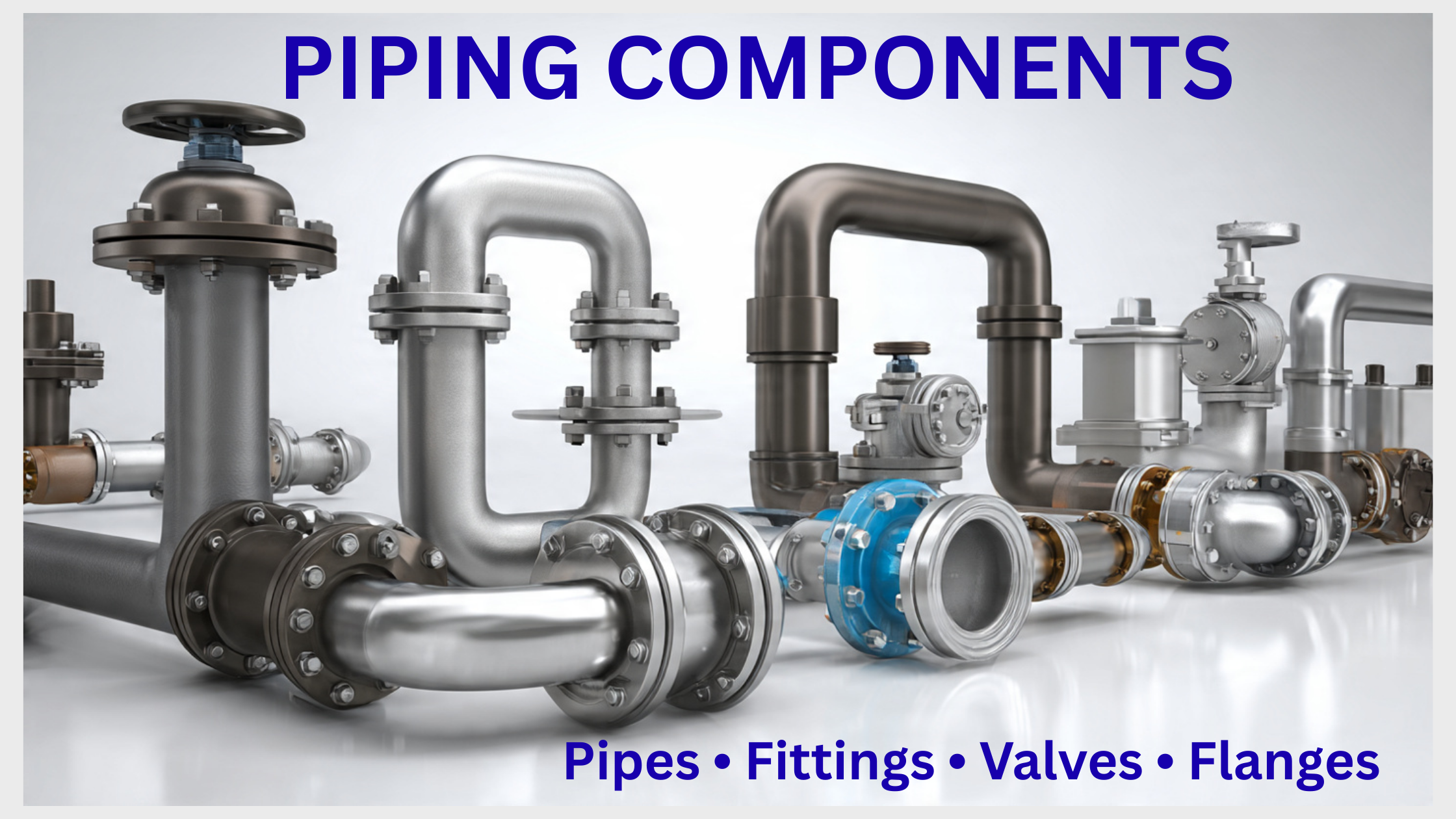
From a practical piping engineering point of view, piping components can be broadly grouped as:
- Pipes
- Fittings
- Flanges
- Valves
- Gaskets and bolting
- Special components (strainers, expansion joints, etc.)
All of these are covered under Piping Components, which form the backbone of plant piping systems. Piping Components (Link to: Piping Basics – Piping Components)
Pipes – The Core of Any Piping System
Pipes are the primary components that carry fluids from one point to another. Pipes are specified by:
- Nominal Pipe Size (NPS)
- Schedule (wall thickness)
- Material
Understanding size terminology is critical for beginners.
<u>NPS, DN & Schedule</u> (Link to: Piping Basics – NPS, DN & Schedule)
From site experience, remember:
- Bigger NPS does NOT always mean thicker pipe
- Schedule controls pressure capacity
- Material controls temperature and corrosion resistance
Pipe Fittings – Direction and Size Control
Fittings are used to change direction, change size, or branch a pipeline. In real plants, fittings are everywhere—often more than straight pipe lengths.
Common Types of Pipe Fittings
Elbows
Used to change flow direction.
- 90° elbows – most common
- 45° elbows – smoother direction change
- Long radius (LR) elbows preferred in process piping
- Short radius (SR) elbows used where space is tight
Tees
Used to take branch connections.
- Equal tee – same size branch
- Reducing tee – smaller branch
Reducers
Used to change pipe size.
- Concentric reducer – vertical lines
- Eccentric reducer – horizontal lines (used in pump suction)
From experience: Never use concentric reducers on pump suction—this causes vapor pockets and pump cavitation.
Flanges – Removable Connections
Flanges are used where piping needs to be dismantled for maintenance. Unlike welded joints, flanged joints are bolted and gasketed.
Common Types of Flanges
- Weld Neck (WN)
- Slip-On (SO)
- Socket Weld (SW)
- Threaded
- Blind flange
Each has its place:
- Weld neck flanges are used for high pressure and high temperature
- Slip-on flanges are cheaper and common in low-pressure services
- Blind flanges are used to close line ends or for hydrotesting
Flanges always work together with gaskets and bolting—never as standalone items.
Valves – Flow Control Devices
Valves are the “switches” of a piping system. They control, isolate, or regulate flow.
Common Types of Valves Used in Plants
Gate Valves
- Used for isolation
- Normally fully open or fully closed
- Not recommended for throttling
Globe Valves
- Used for flow regulation
- Higher pressure drop
- Common in control applications
Ball Valves
- Quick operation (quarter turn)
- Tight shut-off
- Very common in process plants
Check Valves
- Prevent reverse flow
- Installed in pump discharge lines
From plant experience: Valve orientation matters. Incorrect installation can lead to hammering, leakage, or failure.
Gaskets and Bolting – Small Parts, Big Responsibility
Many beginners underestimate gaskets and bolts. In reality, most leakage problems happen at flanged joints, not pipes.
Gaskets
- Soft gaskets (CAF, graphite, PTFE)
- Metallic gaskets (RTJ)
Selection depends on:
- Pressure
- Temperature
- Fluid type
- Flange facing
Bolting
- Carbon steel bolts for low temperature
- Alloy steel bolts for high temperature
- Correct bolt material pairing with flange is essential
Improper bolting torque is a very common site mistake.
Special Piping Components Used in Plants
Beyond basic items, plants also use special components such as:
- Strainers – protect equipment
- Expansion joints – absorb thermal movement
- Flexible hoses – vibration isolation
- Spectacle blinds – positive isolation
- Steam traps – condensate removal
These components are usually shown clearly on P&IDs and must be handled carefully during design and installation.
Effect of Pressure, Temperature, and Fluid on Components
Piping components are selected based on design conditions, not operating conditions.
- High pressure → thicker pipes, higher class flanges
- High temperature → alloy materials, creep considerations
- Corrosive fluids → stainless steel or lined piping
Material loss due to corrosion is accounted for using corrosion allowance.
<u>Corrosion Allowance</u> (Link to: Piping Basics – Corrosion Allowance)
Material Standards and Specifications (ASME & ASTM – Simple Explanation)
Most piping components are manufactured according to international standards.
ASTM
Defines material chemistry and mechanical properties
Example:
- ASTM A106 Gr.B – carbon steel pipe
- ASTM A105 – carbon steel flanges
ASME
Defines design rules and dimensions
Example:
- ASME B16.5 – flanges
- ASME B16.9 – fittings
- ASME B31.3 – process piping code
Think of it this way:
- ASTM tells you what the material is
- ASME tells you how it is used
Common Mistakes in Piping Components Selection (From Experience)
After years in projects, these mistakes appear again and again:
- Using wrong reducer type at pump suction
- Mixing flange rating and pipe rating
- Incorrect valve orientation
- Ignoring gasket compatibility with fluid
- Assuming “same size” means “same rating”
- Not considering maintenance access for valves
These errors don’t always show on drawings—but they show up painfully during commissioning.
Why Understanding Piping Components Matters for Your Career
If you understand piping components well:
- You read P&IDs faster
- You avoid basic site mistakes
- You gain confidence in design reviews
- You communicate better with construction teams
Strong fundamentals in piping components separate average engineers from reliable ones.
FAQ
1. What are piping components?
Piping components are the individual items used to build a complete piping system. These include pipes, fittings, flanges, valves, gaskets, bolting, and special items like strainers and expansion joints. Each component has a specific function such as carrying fluid, changing direction, controlling flow, or allowing maintenance. Together, they ensure safe and reliable operation of industrial piping systems.
2. What are the main piping components used in process plants?
The main piping components commonly used in oil & gas, chemical, and power plants are:
- Pipes – to transport fluids
- Fittings – elbows, tees, reducers for direction and size change
- Flanges – for removable joints
- Valves – for isolation, control, and flow regulation
- Gaskets and bolting – to seal flanged joints
Special components like strainers, steam traps, and expansion joints are also used depending on service requirements.
3. Why is correct selection of piping components important?
Correct selection of piping components is critical for safety, reliability, and long service life. Wrong selection can lead to leakage, corrosion, excessive pressure drop, vibration, or equipment damage. Proper component selection considers pressure, temperature, fluid type, material compatibility, and applicable codes such as ASME and ASTM. Most plant failures are linked to basic mistakes in component selection rather than pipe failure itself.
Summary
- Piping components are the building blocks of any piping system
- Pipes, fittings, flanges, valves, gaskets, and bolting must work together
- Selection depends on pressure, temperature, fluid, and standards
- Small components can cause big failures if selected wrongly
- Real-world experience always proves fundamentals matter
Mastering piping components is not optional—it is the foundation of safe and efficient piping engineering. If you build this foundation strong, everything else in piping design becomes easier.
1 thought on “Piping Components Basics: A Practical Guide for Junior Piping Engineers”