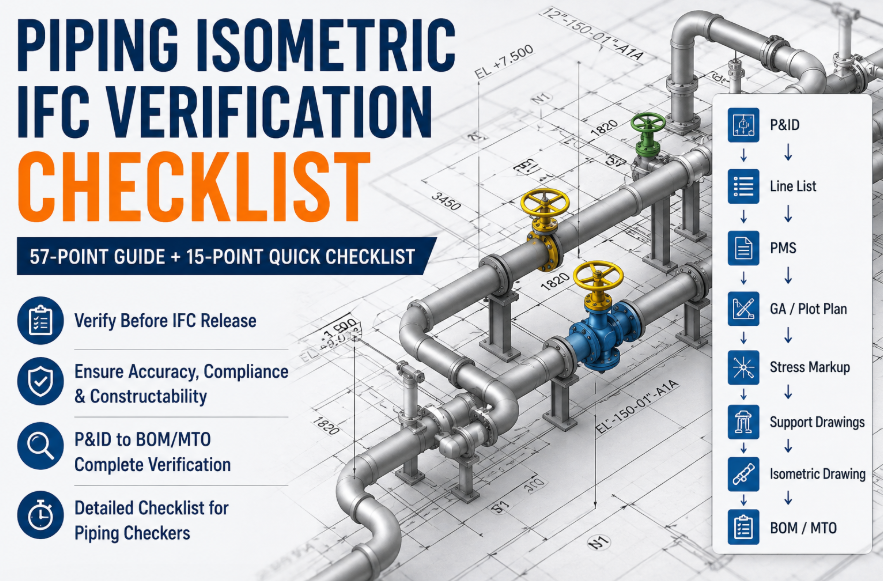
Piping Isometric IFC Verification Checklist In many EPC projects, piping checkers work under tight schedules and face constant pressure to release Isometric Drawings for Construction (IFC) on time. At the same time, every drawing must be checked carefully to ensure that all engineering requirements, dimensions, materials, supports, and design information have been incorporated correctly.
Before reviewing an IFC isometric, it is important to understand how piping isometric drawings are prepared and interpreted.
This is where a systematic piping isometric drawing checklist becomes essential.
Before approving an IFC isometric, piping engineers and checkers often ask:
“What should I verify before approving an IFC Isometric?”
A proper IFC isometric checking checklist helps ensure that critical details are not overlooked during the review. It provides a structured approach for checking piping layouts, dimensions, valves, fittings, supports, specifications, and other essential drawing information.
Some companies use detailed checklists containing 50+ verification points, while others rely mainly on the experience of the piping checker. Both approaches can be effective when applied correctly.
A comprehensive piping checker checklist helps ensure that nothing is missed, while a condensed checklist allows experienced engineers to perform a quick and effective piping IFC drawing review.
In this article, I will share both:
- A detailed 57-point Piping Isometric IFC Verification Checklist
- A practical 15-point IFC Isometric Checking Checklist for daily reviews
- Key items to verify before approving an IFC piping isometric drawing
- Common checks performed during a piping IFC drawing review
The objective is simple: to make sure every piping isometric is accurate, complete, and ready for construction before IFC approval.
Table of Contents
Why Is IFC Isometric Checking Important?
An Isometric Drawing is one of the most critical deliverables in a piping project.
It is used by:
- Fabrication shops
- Construction teams
- Material control teams
- Quality departments
- Inspection agencies
Any error in the Isometric can lead to:
- Fabrication rework
- Site modification
- Incorrect material procurement
- Cost overruns
- Construction delays
Therefore, the Isometric should never be checked in isolation.
A good checker always verifies the source documents first.
Document Verification Sequence Before IFC Isometric Release
Before reviewing an Isometric, verify the following documents:
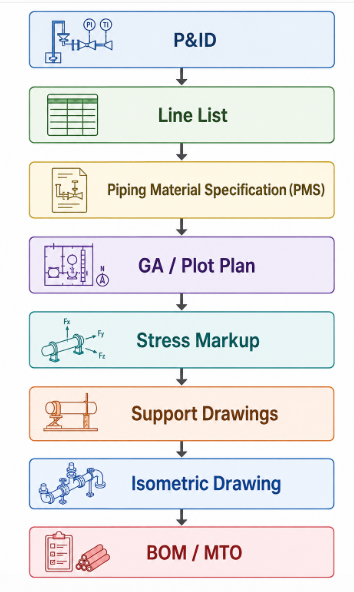
The above sequence forms the foundation of an effective piping isometric drawing checklist. Each document provides essential information that must be verified before the final isometric is approved for IFC release.
Piping Isometric IFC Verification Checklist: 57-Point Guide
The following sections represent a detailed review approach commonly followed on large EPC projects.
Section 1: P&ID Verification
The P&ID is one of the primary engineering inputs used during an IFC isometric review. Understanding P&ID symbols and flow diagrams helps the checker verify process connections and valve information correctly.
Verify:
- Line number matches P&ID
- Line size matches P&ID
- Valve tags match P&ID
- Instrument connections are shown
- Vent connections are provided
- Drain connections are provided
- Special items match P&ID requirements
Section 2: Line List Verification
The line number and designation should also be checked against the project Line List. Understanding line designation in piping design helps identify discrepancies between the Line List and isometric.
Verify:
- Line size is correct
- Design pressure is correct
- Design temperature is correct
- Fluid service is correct
- Insulation requirements are included
Section 3: PMS Verification
Pipe, fittings, flanges, valves, gaskets, and other components should be verified against the applicable piping material requirements. A basic understanding of piping materials is useful when performing this check.
Verify:
- Pipe class matches PMS
- Pipe schedule is correct
- Fitting specifications are correct
- Flange ratings are correct
- Valve ratings are correct
- Gasket specifications are correct
Section 4: GA / Plot Plan Verification
Verify:
- Routing matches layout
- Equipment nozzle orientation is correct
- Pipe elevations are correct
- Coordinates are correct
- Required slope is maintained
- Maintenance access is available
Section 5: Stress Verification
Thermal expansion and flexibility requirements are particularly important for critical piping systems. The checker should confirm that applicable stress-analysis comments have been incorporated into the final isometric.
Verify:
- Stress comments have been incorporated
- Spring supports have been incorporated
- Guide locations are correct
- Anchor locations are correct
- Dummy supports are provided as required
- Flexibility requirements are maintained
Section 6: Pipe Support Verification
Verify:
- Support tags are shown
- Support locations are correct
- Support types are correct
- Structural attachment points are feasible
- Support spacing complies with project requirements
Section 7: Isometric Verification
Dimensions, elevations, coordinates, weld information, spool breaks, and other details should be clearly represented on the piping isometric. For a detailed explanation of how piping isometrics are developed, see our guide to piping isometrics.
Verify:
- Dimensions are complete
- Elevations are complete
- Coordinates are complete
- Weld numbers are assigned
- Shop welds are identified
- Field welds are identified
- Spool breaks are identified
- Valve accessibility is acceptable
- Constructability review has been completed
Section 8: BOM / MTO Verification
Correct identification of pipes, fittings, flanges, valves, and other piping components is essential for accurate BOM/MTO generation.
Verify:
- Pipe quantities are correct
- Fitting quantities are correct
- Valve quantities are correct
- Flange quantities are correct
- Gasket quantities are correct
- Bolt quantities are correct
- Material descriptions are correct
- MTO matches piping specifications
Final Release Verification
Before IFC Release
- All review comments have been closed
- Design compliance has been confirmed
- Construction readiness has been confirmed
- Fabrication requirements have been incorporated
- IFC release is recommended
The Practical 15-Point IFC Checklist
Although the 57-point checklist is useful, most checkers do not have time to perform such a detailed review on every line.
For day-to-day engineering work, I prefer focusing on the following 15 critical checks.
These checks typically identify most of the issues that can impact fabrication and construction.
| Sl. No. | Critical Check |
| 1 | Line number matches P&ID |
| 2 | Line size and specification match Line List and PMS |
| 3 | Routing matches GA / Plot Plan |
| 4 | Pipe elevations and coordinates are correct |
| 5 | Required slope is maintained |
| 6 | Valve tags and orientations are correct |
| 7 | Vent and drain requirements are incorporated |
| 8 | Instrument connections are correct |
| 9 | Stress comments are incorporated |
| 10 | Critical support locations are verified |
| 11 | Maintenance and operation clearances are available |
| 12 | Shop weld and field weld locations are identified |
| 13 | Spool breaks are practical for fabrication |
| 14 | BOM/MTO quantities are correct |
| 15 | Material descriptions comply with PMS |
The 5-Minute Senior Checker Rule
When time is very limited, I focus on five major areas first.
1. P&ID Compliance
Verify that the Isometric fully reflects the process intent.
2. PMS Compliance
Verify that all materials comply with project specifications.
3. Routing and Elevations
Incorrect routing or elevations can create major construction issues.
4. Stress and Support Requirements
Ensure all stress comments, guides, anchors, and support requirements are incorporated.
5. BOM and MTO Accuracy
Incorrect materials or quantities directly impact procurement and fabrication.
These five areas alone can identify most major deviations before IFC release.
Common Issues Found During IFC Checking
Some of the most frequent issues encountered during Isometric reviews include:
- Incorrect piping specification
- Missing support information
- Wrong valve orientation
- Missing drains and vents
- Elevation mismatches
- Incorrect spool breaks
- Missing field welds
- BOM quantity discrepancies
- Missing stress requirements
- Fabrication accessibility problems
Identifying these issues during engineering review is significantly cheaper than correcting them during construction.
Final Thoughts
A well-checked Isometric helps avoid fabrication problems, material shortages, and site rework.
Whether you use a detailed 57-point checklist or a quick 15-point review, the most important thing is to follow a structured verification process.
Always remember:
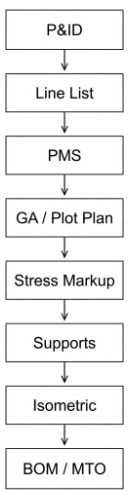
Following this sequence ensures that the Isometric is reviewed using the correct engineering inputs before being released for construction.
Golden Rule
Never check an Isometric in isolation. Verify the source documents first, then verify the Isometric, and finally verify the BOM/MTO.
That simple habit can prevent many costly errors before they reach the fabrication shop or project site.